If you’re reading this article, then that means that you’re now viewing my blog at its new home of Bluehost.com. (And if you’re not reading this, then you have officially achieved a state of ultimate paradox. Congratulations.)
I’ve taken the opportunity of moving the blog to make a number of changes, which I list below:
- Infoquake site is now on WordPress. The Infoquake website is now running on good ol’ WordPress (as opposed to ColdFusion, which is what I originally created the site in). This means it will be a heck of a lot easier for me to maintain, and will allow me to install nifty plug-ins and the like.
 Plus once I do the redesign in 2008, all I’ll need to do is modify the skin and I’m good to go — no need to reprogram the whole thing. But the coolest thing about moving to WordPress? I can use the IMM-Glossary plugin to give me automatic popup definitions for the terms in the book. Go look at the excerpt page and run your mouse over one of the words with the dotted underlines to see it in action. (Or just look at the screen cap to the right.)
 - The John Barth Information Center is also now on WordPress. Some of you may or may not realize that I’ve maintained a fan website devoted to the Postmodernist author John Barth for the past, oh, 12 or 13 years. (Go ahead, search Google for “John Barth” and see what comes up just below the Wikipedia article. I’ll wait.) This site is now running WordPress too, and seeing as I’ve been such a horrible steward of the site, I’m hoping to open it up to other John Barth fans to write, administer, comment, and manage.
- All my personal websites are now running on LAMP. Yes, I do frequently defend Microsoft and have not always been keen on open source software. But I’ve decided to move to an all-open source LAMP (Linux, Apache, MySQL, and PHP) environment, because a) it’s cheaper, and b) WordPress runs better that way.
- Cleaner permalinks. If you look at your browser address bar, you’ll notice that the “/blog” is gone. As is the “index.php” and the date-based URL. Why? Well, it’s cleaner, that’s why. Whereas the old WordPress installation had permalinks in the form www.davidlouisedelman.com/blog/index.php/year/month/day/title/, the new installation shows permalinks in the form www.davidlouisedelman.com/category/title/. Much easier to read, and much more search engine-friendly. (Yet thanks to the magic of John Godley’s Redirection plug-in, you can still follow old links to the new pages. Really, this thing is a miracle — regular expression-based redirection, just like in Apache, but you don’t have to leave WordPress or mess with .htaccess files. Plus 404 logging, and more.)
- My old book reviews and interviews are now part of the blog. If you take a look at the full archives page, you’ll notice that I now have blog entries dating back to 1994. No, I wasn’t the most prescient individual in the world, I’ve simply moved all of my old book reviews and author interviews from the mid-90s into WordPress. This means they’re accessible through the search and the archives and get the benefits of tagging and all that WordPress-y goodness. You can read my Baltimore City Paper interviews with Tim O’Brien, Nicholson Baker, and Stephen Hunter here — still three of the most popular pages on the website — and more.
- I’ve licensed the pieces on this blog with Creative Commons. The pieces on this blog now come with an Attribution-Share Alike Creative Commons license. Which means you’re free to copy them and remix them in any fashion you’d like, as long as you attribute the original to me and share your copies and remixes yourself. I really have no idea what this is going to do for me; I figure that it will either a) help, or at least b) not cost me anything.
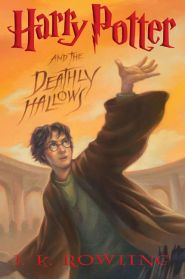 I predicted that Harry, Ron, and Hermione would all live to the end of the series, though J.K. would keep us in suspense until the last minute. Bing! I predicted that Snape would reveal that he had killed Dumbledore and turned Death Eater on Dumbledore’s orders. Bing! I predicted that Harry would triumph over Voldemort at the expense of lots of secondary characters. Bing! I predicted that Harry would find some way to contact Sirius Black again from beyond the grave. Well, no bing! there, but I’d suggest that I deserve a partial bing! since Harry does manage to contact another dead mentor (Dumbledore) from beyond the grave.
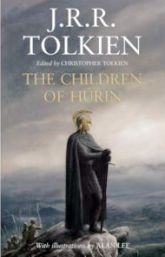 Sador is speaking here about the race of Men, and his statement may sum up Tolkien’s recently published novel as good as any. Children of Húrin is a tale about fear and Man’s futile attempts to wrest honor and courage from the jaws of certain doom. It’s a major new work, though incomplete, and one of the clearest distillations of Tolkien’s thought since the publication of The Silmarillion in the late ’70s.
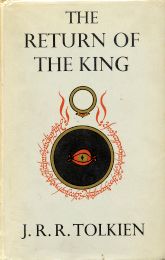 So there were all kinds of gems awaiting me on my re-reading of ROTK. I had completely forgotten about Beregond, Guard of the Citadel, and the heroic role he plays in saving Faramir from death at the hands of Denethor. I had only a faint recollection of Ghân-buri-Ghân and the Wild Men. I didn’t recall that our heroes have a run-in with Saruman before the Hobbits return to the Shire. I had forgotten that the only reason Merry was able to wound the Lord of the Nazgûl was because of his sword, picked up at the Barrow-downs in the early chapters of Fellowship.
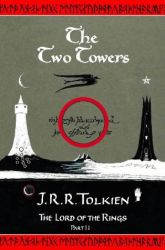 It’s a difficult book. Frodo and Sam, the characters we’re most invested in, disappear for a couple hundred pages; Gandalf is presumably dead in the book’s opening chapters; Boromir’s definitely dead; and Aragorn is still something of a distant figure. Gimli is interesting enough but hardly crucial to the plot, and it’s difficult to give two figs about Legolas.
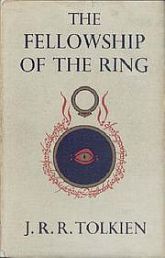 But more importantly, in an ideal world one would be able to discuss The Fellowship of the Ring without being overshadowed by Peter Jackson’s film of the same name. Unfortunately, for me that’s impossible. I’ve seen the films probably a dozen times each since their release, enough that I can recite most of the dialogue word for word. The Extended Edition of Fellowship is one of my favorite films ever, ever, ever.
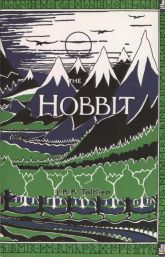 If you’re going to read the complete works of Tolkien properly, you definitely should not follow The Silmarillion with The Hobbit. (